


Page 1823 - trc_centennial_deir201705
P. 1823
NOT FOR PUBLIC REVIEW                                                   5.18 Water Resources

               recycled water demand for slopes of approximately 1,008 afy (see Table 5.18-7). Consistent
               with the Peer Review Report, the Project water demand includes a plant establishment factor
               to account for water use required during the initial phases of landscape establishment.

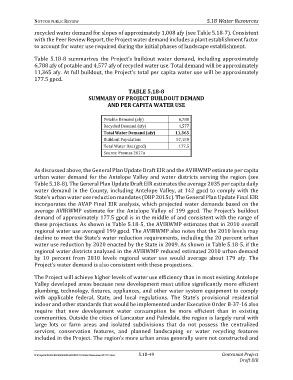
               Table  5.18-8  summarizes  the  Project’s  buildout  water  demand,  including  approximately
               6,788 afy of potable and 4,577 afy of recycled water use. Total demand will be approximately
               11,365 afy. At full buildout, the Project’s total per capita water use will be approximately
               177.5 gpcd.

                                                       TABLE 5.18-8
                                      SUMMARY OF PROJECT BUILDOUT DEMAND
                                              AND PER CAPITA WATER USE

                                            Potable Demand (afy)            6,788
                                            Recycled Demand (afy)           4,577
                                            Total Water Demand (afy)      11,365
                                            Buildout Population            57,150
                                            Total Water Use (gpcd)          177.5
                                            Source: Psomas 2017a

               As discussed above, the General Plan Update Draft EIR and the AVIRWMP estimate per capita
               urban water demand for the Antelope Valley and water districts serving the region (see
               Table 5.18-8). The General Plan Update Draft EIR estimates the average 2035 per capita daily
               water demand in the County, including Antelope Valley, at 142 gpcd to comply with the
               State’s urban water use reduction mandates (DRP 2015c). The General Plan Update Final EIR
               incorporates the AVAP Final EIR analysis, which projected water demands based on the
               average  AVIRWMP  estimate  for  the  Antelope  Valley  of  199  gpcd.  The Project’s buildout
               demand of approximately 177.5 gpcd is in the middle of and consistent with the range of
               these projections. As shown in Table 5.18-5, the AVIRWMP estimates that in 2010 overall
               regional water use averaged 199 gpcd. The AVIRWMP also notes that the 2010 levels may
               decline to meet the State’s water reduction requirements, including the 20 percent urban
               water use reduction by 2020 enacted by the State in 2009. As shown in Table 5.18-5, if the
               regional water districts analyzed in the AVIRWMP reduced estimated 2010 urban demand
               by  10  percent  from  2010  levels  regional  water  use  would  average  about  179  afy.  The
               Project’s water demand is also consistent with these projections.

               The Project will achieve higher levels of water use efficiency than in most existing Antelope
               Valley developed areas because new development must utilize significantly more efficient
               plumbing, technology, fixtures, appliances, and other water system equipment to comply
               with  applicable  federal,  State,  and  local  regulations.  The  State’s  provisional  residential
               indoor and other standards that would be implemented under Executive Order B-37-16 also
               require  that new development water consumption be  more efficient  than  in  existing
               communities. Outside the cities of Lancaster and Palmdale, the region is largely rural with
               large  lots  or  farm  areas  and  isolated  subdivisions  that  do  not  possess  the  centralized
               services,  conservation  features,  and  planned  landscaping  or  water  recycling  features
               included in the Project. The region’s more urban areas generally were not constructed and


               R:\Projects\PAS\CEN\000306\Draft EIR\5.18 Water Resources-051117.docx   5.18-49   Centennial Project
                                                                                                     Draft EIR

